Ramiro Labs / Full-stack MVP
Split — AI Scheduling App
AI auto-schedules todos in under 30 seconds
Built a full-stack productivity SaaS that unifies todos, habits, and calendar events under AI-powered auto-scheduling — so users never have to manually time-block again.
- Next.js
- Convex
- TypeScript
- Stripe
- Google Calendar API
- Outlook API
- Google Gemini
- PostHog
- Sentry
- Vitest
- Playwright
title: "Split — AI Scheduling App" client: "Ramiro Labs" category: "Full-stack MVP" date: "2026-04-01" outcome_metric: "AI auto-schedules todos in under 30 seconds" description: "Built a full-stack productivity SaaS that unifies todos, habits, and calendar events under AI-powered auto-scheduling — so users never have to manually time-block again." tech_stack:
- Next.js
- Convex
- TypeScript
- Stripe
- Google Calendar API
- Outlook API
- Google Gemini
- PostHog
- Sentry
- Vitest
- Playwright live_url: "https://usesplit.app" cover_image: "/case-studies/case-study-4/cover.png" isFeatured: true featured_order: 4
Problem
Productivity apps solve the wrong problem. Most of them are good at capturing tasks — and terrible at getting them done. The gap between "I have a list" and "I know exactly what I'm doing at 2pm Tuesday" gets bridged manually, which is itself a significant cognitive load that people either procrastinate on or skip entirely.
The users who feel this most acutely are builders juggling multiple projects and identities: too many commitments to track in their head, too many shifting priorities to maintain a static schedule, and too little time to maintain the productivity system that's supposed to save them time.
Approach
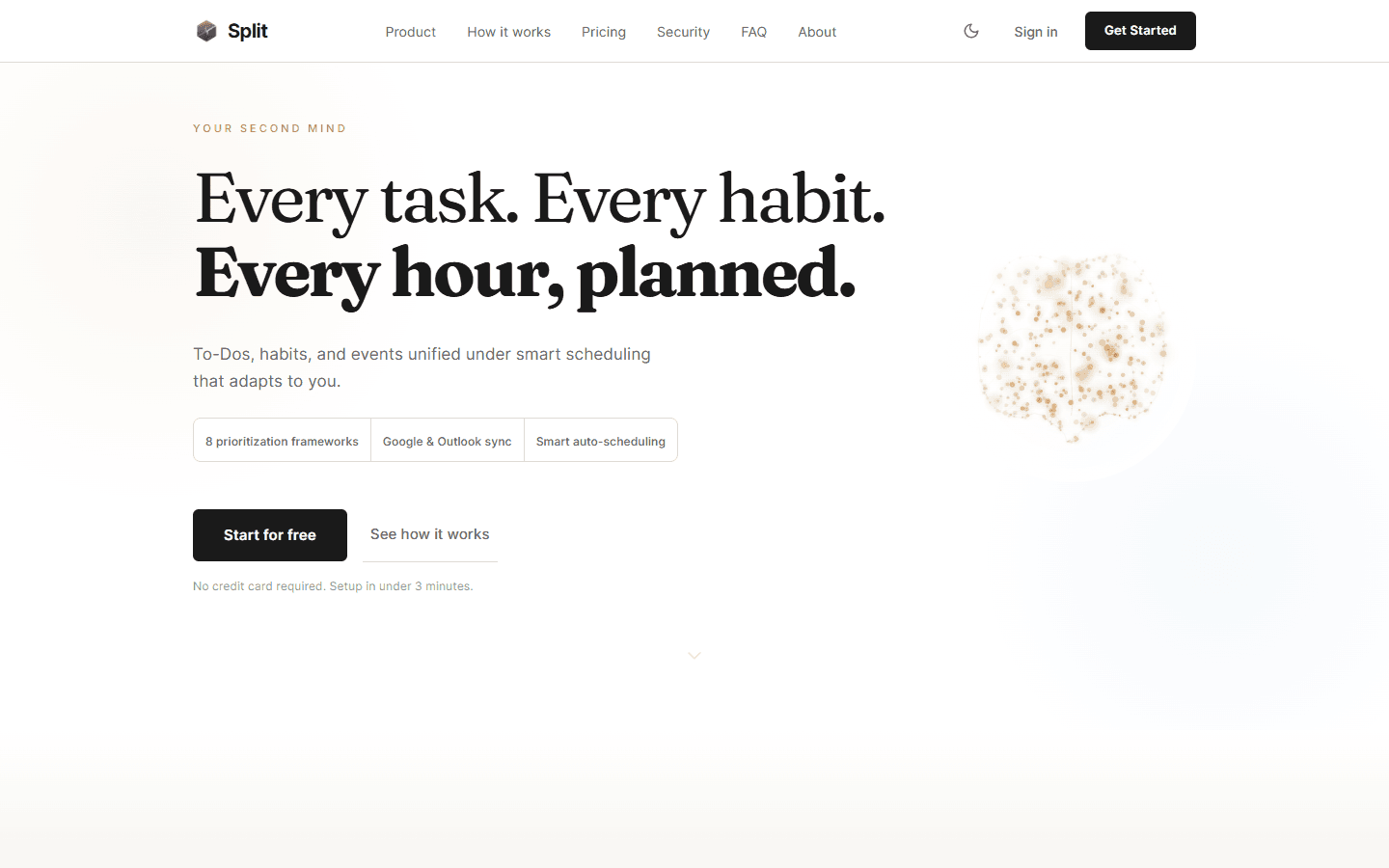
Split's core insight is that auto-scheduling — not better task capture — is what users actually need. The app ingests todos, habits, and calendar events into a unified model, then places them onto the calendar automatically using 8 prioritization frameworks (including Eisenhower, Action Priority, and Value vs. Complexity). Users choose their framework; Split builds the schedule.
The real-time sync layer (Convex) keeps todos, habits, and calendar state consistent across devices without manual refresh. Calendar integrations (Google Calendar, Outlook) are bidirectional — events from the user's existing calendar are considered when scheduling new items.
The AI Daily Brief generates a prioritized morning summary using Gemini, giving users a single decision on how to orient their day instead of re-triaging a backlog. Message reminders surface check-ins and follow-ups for the relationship maintenance that gets dropped when work gets heavy.
The test suite — 505 tests across Vitest unit/integration and Playwright E2E — reflects a deliberate commitment to shipping without regressions, built adversarially with Codex-generated edge case probes against every new feature before it shipped.
Outcome
Split launched to early access with free web signup (no credit card, setup under 3 minutes). The auto-scheduling system places items onto the calendar in under 30 seconds on a warm session. The v0.1.4 release shipped 5 security fixes identified through adversarial code review, timezone hardening, a DST edge-case fix, and legal pages — with the 505-test baseline maintained throughout.
Technical highlights
- Real-time sync: Convex backend keeps todos, habits, and calendar state consistent across devices
- Auto-scheduling: 8 prioritization frameworks, no manual time-blocking required
- Calendar integrations: Google Calendar and Outlook (bidirectional), Apple Calendar planned
- AI features: Gemini-powered Daily Brief and auto-scheduling suggestions
- Test coverage: 505 tests (Vitest workspace + Playwright E2E), adversarially tested with Codex probes
- Observability: PostHog product analytics + Sentry error tracking from day one
Tech stack
- Next.js
- Convex
- TypeScript
- Stripe
- Google Calendar API
- Outlook API
- Google Gemini
- PostHog
- Sentry
- Vitest
- Playwright
Want something like this?
Send a short brief. I'll reply within 2 business days.
Start a brief