Case Study
Quantum Simulator Validation
Built a correctness + benchmarking harness around a pure-Python statevector simulator, validating expected protocol behavior and quantifying scaling limits.
At a Glance
Key Metrics
Test Coverage
167+ tests
146 unit + 21 integration
Benchmarking
n >= 5 runs
Mean +/- std, fixed seeds
Scaling
~2-4x / qubit
Expected exponential trend
Ops Timing
10-20 us
Noise channel ops (mean)
TL;DR
Implemented a simulation-only validation stack: 167+ tests (unit + integration), reproducible benchmarks (>=5 runs, mean +/- std, fixed seeds), and a reportable performance profile. Benchmarks show expected O(2^n) scaling, microsecond-level operation timings, and explicit memory growth consistent with theory.
Background
Context / Problem
Quantum software teams rely on simulators for debugging, validation, and benchmarking -- but simulators are easy to get subtly wrong. The goal was to build a validation framework that makes correctness claims defensible and performance characteristics explicit, using simulation only.
Constraints
Evaluation Plan
Correctness-first
Unit + integration tests for state evolution, measurement, and protocol behavior.
Reproducibility
Fixed seeds, repeated runs (n >= 5), mean +/- std, and recorded environment metadata.
Performance transparency
Measure scaling, memory growth, and key operation timings.
Approach
Process
Built a layered validation approach: unit tests for linear-algebra primitives and channels, integration tests for full protocol workflows, and benchmarks that report mean/std across repeated runs. Report generation is automated via LaTeX tables/figures to keep the output audit-friendly and consistent.
Deliverables
Solution
Test suite: 167+ tests spanning decoherence, error correction, and nonlocal games.
Benchmark harness: scalability runs, operation microbenchmarks, and memory accounting.
Report pipeline: reproducible tables/figures and compile instructions for PDF.
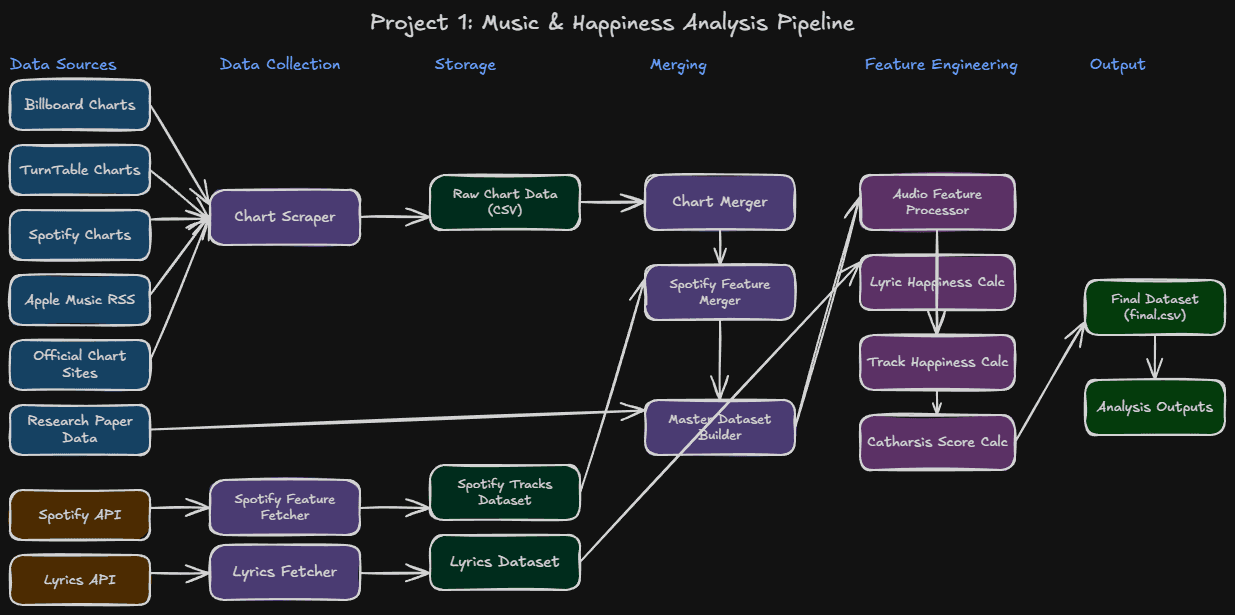
Architecture Diagram
Visualization
Exponential Scaling Explorer
Toggle between views to explore how simulation cost grows exponentially with qubit count. Each metric confirms the expected O(2^n) theoretical scaling.
Circuit Simulation Time
Time vs qubit count at depth = 50. Each additional qubit roughly doubles to quadruples wall-clock time.
O(2^n) exponential scaling confirmed
Benchmarks
Performance Profile
Noise Channel Operation Costs
Mean execution time for noise channel application (microseconds)
Error Correction Fidelity
Fidelity before and after correction across increasing error rates (gamma). Correction restores F = 1.000 at every tested noise level.
gamma = 0.01
gamma = 0.05
gamma = 0.10
gamma = 0.15
gamma = 0.20
Outcomes
Results
Results below are from simulation-only benchmarking and validation. They quantify expected scaling behavior, operation-level costs, and explicit memory growth for statevector simulation.
| Category | Metric | Result |
|---|---|---|
| Testing | Coverage | 167+ tests (146 unit, 21 integration) |
| Scaling | Time vs qubits (depth=50) | 2q: 0.012658s; 3q: 0.041701s; 4q: 0.155296s |
| Ops | Gate application cost | 2q: 40.3us; 4q: 509.0us; 6q: 7837.3us (mean) |
| Noise | Channel cost (mean) | Phase damping 12.1us; amp damping 19.9us; depolarizing 10.7us |
| Memory | State size vs qubits | 6q: 0.000977MB; 8q: 0.003906MB |
This is a software engineering artifact: correctness discipline, benchmark design, quantified scaling limits, and reproducible reporting.
Recruiter Takeaway
Documentation
Technical Validation & Benchmarks
Includes comprehensive unit, integration, and performance testing of a Python-based quantum simulator, with benchmarks covering scalability, memory usage, and noise/error-correction overhead. Results are reported with reproducible methodology (fixed seeds, repeated runs, summary statistics).
Reflections
Learnings
Test suites in scientific/quantum code must prove invariants (norm, statistics), not just outputs.
Benchmark methodology matters: fixed seeds, repeated runs, and variance reporting prevent self-deception.
Making scaling limits explicit (time + memory) builds trust and guides engineering decisions.
Attribution
Role
Designed and implemented the test suite, benchmark harness, and reporting pipeline. All results are simulation-only.
Future Work
What I'd Do Next
Introduce a NumPy backend and compare speed/accuracy vs pure Python.
Add larger circuit benchmarks and memory profiling plots.
Add CI to run tests + lightweight benchmark smoke-test on each change.